EEG, color film.
Brain activity is vector interactions, direct with internal organs and
indirect
with stimuli from the external environment, through the sense organs.
EEG displays graphs on the screen, the speed of "sharp-peaked oscillations"
of electrical fields. These manifestations, reminiscent of "frog's
leg contraction"
are rather variations of the potential of some vector polarizations.
So, the connections of neurons with internal organs are vector polarizations.
If so, the complexity of brain activity can be displayed on the screen,
as a
color image, with topological information. That is, a complete spectral
map
of brain activity, the sensors detecting
separately the oscillations of the
L–M–H potentials depending on the frequency. Let's consider
a sensor,
two parallel and thin conductors, the positive and negative terminals
of two
antiparallel diodes, the other terminals being connected to the terminals
of a
capacitor. The potential at the terminals of the capacitor is enough to
directly bias the diodes. The diode polarities attract the polarities
with
opposite signs of the detected polarizations from a distance, closing
the
circuit and increasing the capacitance potential. The increased potential
represents the information of the activity of the population of neurons
on
the L-M-H frequencies. The potential value is increased depending on the
frequency, differentiating the L-M-H channels but adjusted to a required
value, by the capacitance value. Therefore, the frequency and capacitance
value select the information on the L-M-H channels. The antiparallel diodes
and the capacitance are powered by a stable external source. It results
that
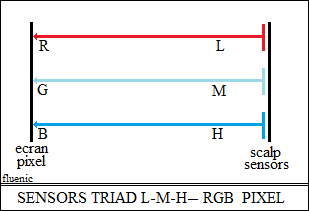
brain activity, through the L-M-H channels, directly modulates the light
of
the RGB diodes in the screen pixels. After making the functional
connections, the L-M-H channels with RGB can be multiplied on
a matrix the size of an acoustic stethoscope. Such a structure can
be used like a stethoscope, with which the film of brain activity is
viewed, palpating the areas of the scalp with this "videoscope".
The screen can also be placed on the back of the videoscope.