Therefore, Energy is the effect of
a cause. The core of stars and planets is
an electrical circuit, the immense density (intensity) of oriented vector
space, compressed by the "magnetic circuit". The core, the electrical
circuit,
compresses the magnetic circuit, only in the segment it surrounds, which
is
called the magnetic axis, the vietorial axis. The repulsive forces in
the
uncompressed magnetic circuit, radially expand, to huge distances, the
density of magnetism, that is, the orientation density of the vector space.
This density, increasing exponentially towards the nucleus, is the density
gradient of the vector space oriented in the macroscopic, asymmetric
structures. The gradient of the sun is extended in the equatorial plane
to 1 - 2 light years. At a radius of 700,000 km from the core, a layer
of
vector space density, suitable for the formation of hydrogen vector
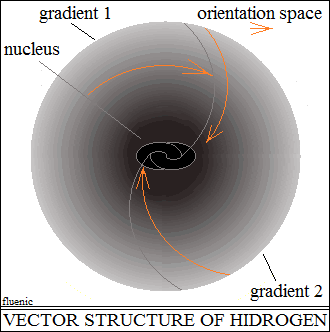
structures, became the photosphere. In the hydrogen structure, the vector
space is oriented in microscopically symmetric orthogonally closed circuits,
because each circuit has its gradient. In other words, each circuit is
asymmetric, having a nucleus and a gradient and orthogonally combined,
producing the symmetry of the structure, as seen in the drawing.
In this configuration, the nuclei with their gradients compress each other,
until a static equilibrium, becoming potential energy. The hydrogen, with
the increased density of space, is moved centripetally by the gradient,
until
the appropriate density, establishing the thickness of the photospheric
layer.
At the appropriate density, the orientation of the space in the gradient
interacts vectorially with the different orientations of the hydrogen,
causing
it to oscillate. The oscillations throw the circuits out of balance, one
nucleus
compresses the other, dilating it simultaneously with its gradient and
the
circuits oscillate between them, the potential energy becomes partially
kinetic.
The dilation and contraction of the gradient moves radially and centripetally
the hydrogen density spectrum, the source of the frequency spectrum,
emitted omnidirectionally. The oscillations, the kinetic energy, decrease
the density of the hydrogen, being displaced radially, from where it came.
The dynamics of hydrogen, composition/decomposition within the limits
of a minimum and maximum density of the oriented vector space is the
characteristic of the photosphere and can be called climate. The evolution
of the sun's structure, after the photosphere formed the planets, the
chromosphere appeared on the photosphere, which shows the climate
change, the decrease in the density of the space in the gradient.
Climate change changes the color of the stars. But, the evidence of climate
change is produced by the evolution of the planets. The climate of the
Earth's photosphere, after the moon formed, decreasing the density from
the
Earth's gradient, the chromosphere becomes the climate of the lavosphere.
The characteristic of the lavosphere is the same as that of the photosphere,
except that the dynamic structures have become chemical elements.
In this layer, the abundance, the density of the hydrogen vector structures,
have united, forming the chemical elements. The increase in the density
of
the oriented space in the chemical elements, moves their structures towards
the center, to the density corresponding to the gradient. The reactions
are
repeated as in the photosphere, the hydrogen bonds in the elements are
broken and are moved radially, from where they came. This dynamic is the
activity of the lava and the evolution of the planet continues, instead
of the
"chromosphere", the lavasphere, which floats on the dark sphere,
becomes
the source that composes the chemical elements, forming the lithosphere.
The lithosphere, floating in turn on the lavasphere and continuously forming
through volcanic eruptions, produces the climate of the atmosphere,
with the dynamics of water. The dynamics of water, with rain and
lightning, formed the right climate for the emergence of the biosphere.
The continuation of the evolution of the earth is already history.