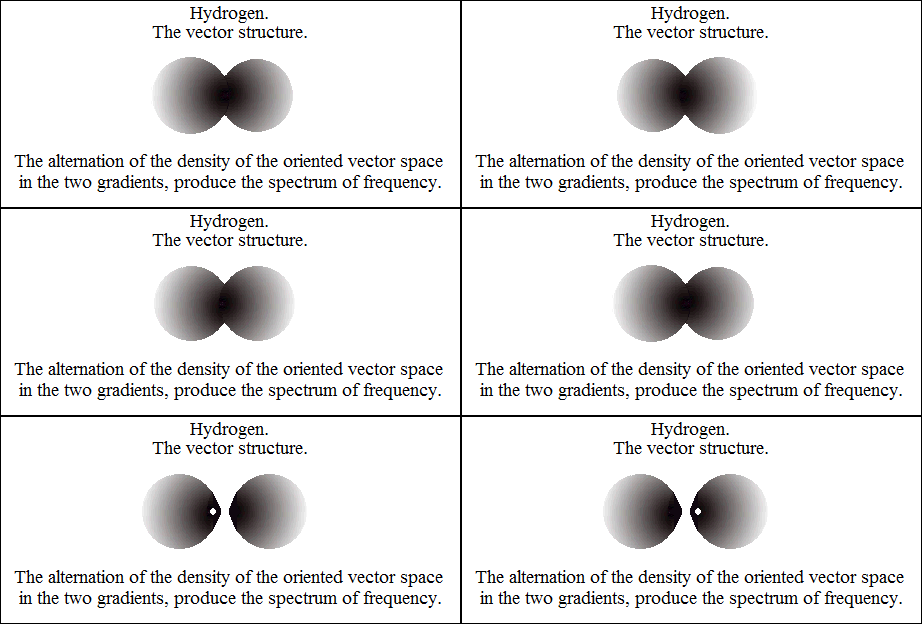
Hydrogen, vector structure.
Hydrogen is not an indestructible atom, it is a microscopic structure
of
vector space oriented in two orthogonally closed circuits. The vector
space
is oriented in a closed circuit, by the vector forces of attraction, whose
module tends to zero and become centripetal forces. The vector space being
oriented parallel, the vector forces of repulsion, expand the density
of the
oriented vector space. The centripetal vector forces in the two circuits
mutually compress the density of the oriented vector space, only on the
surrounded segment. On the segments of the unsurrounded circuits, the
repulsive forces expand the density of the oriented vector space, forming
the density gradients of the oriented vector space. In gradient, the density
of
the oriented vector space increases exponentially towards the center of
the
hydrogen structure. The interactions of the vector properties in the structure,
read carefully, reveal a symmetric hierarchy of the density of the oriented
vector space in gradients. Therefore, in the vector structure of hydrogen,
there is no nucleus, in the center,
there is the maximum limit of the density
of the vector space oriented in gradients. The structure of hydrogen with
gradients, does not have a spherical shape, rather a shape of the figure
8.
It follows that neither the structures in the table of elements, composed
of
hydrogen, can have a nucleus nor spherical shapes. The spherical shape
comes from John Dalton's atom, confirmed by Rutherford's experiment,
in which he also established the existence of the nucleus. To reflect
on the
tiny size of the hydrogen structure, which is the fundamental structure
of the
formation of objective nature. The characteristic of hydrogen structures
is
the property of oscillating and connecting with each other through closed
vector circuits. In the structure of hydrogen, the two circuits compress
each
other's density, until they reach a static equilibrium and enter the potential
energy state. Obviously, when a stimulus amplifies the density of a gradient,
it implicitly produces the alternation of the density of the vector space
oriented in the two gradients. The structure enters the kinetic state
of
energy, producing the frequency spectrum. Hydrogen has as a generation
medium, only a density of orientation of the vector space
from the gradients of the macroscopic vector structures.
Clarification.
The orientation and density of vector space are the effects of
the vector
property of orthogonality (right-hand rule). Oriented vector space in
orthogonally closed circuits cannot be traversed, it is the vector property
of orthogonality. This property delimits orthogonally closed circuits,
making visible the objective existence of vector structures. Thus, the
oriented space of orthogonally closed circuits mutually compresses
its orientation density, through the forces of attraction and repulsion.
The macroscopic structures are asymmetric, one circuit is completely
surrounded and compressed by the other and becomes a solid, visible,
black torus. The torus, in turn, orients and compresses the orthogonal
circuit, only the segment it surrounds. The vector repulsive forces expand
the density of the oriented vector space in the uncompressed circuit with
the
torus, forming the gradient of the density of the oriented space, invisible.
In the gradient, the density of the oriented space increases exponentially
towards the center of the structure. Only in this gradient is there a
density of
oriented vector space, in which symmetrical microscopic vector structures,
hydrogen, can form. The oriented space in hydrogen structures increases
its
density and Archimedes' law moves them towards the center, towards the
higher density. But, the exponentially increasing density towards the
center,
aligns the orientation of space in the hydrogen structure and tends to
break
it down. The hydrogen structure enters into oscillations, decreases the
density and is moved upwards by Archimedes' principle. The dynamics of
hydrogen movement between two limits of the density from gradient and
forms the photosphere of the macroscopic structure, with eruptions.
Towards the center of the structure, the photosphere covers a dark sphere,
in which the density of the oriented vector space is increasing exponentially.
The visible photosphere is the only structure with kinetic energy of stars,
the rest are, the gradient and the dark sphere in the potential energy
state.
Depending on the size of the macroscopic structures, the photosphere
produces the dynamics of the structures of bonded hydrogen, the
chromosphere, present in the planet Jupiter. The chromosphere produces
the
dynamics of the structures in the table of elements, the lavosphere of
the earth
with eruptions, which produce the lithosphere, the atmosphere and the
biosphere.