The enigma of the universe.
There is no matter in the universe, matter is just a dogma in the culture
of
terrestrial civilization. The achievements of electromagnetic technologies,
up
to artificial intelligence, are interactions of vector properties, accomplished
exclusively empirically. In the universe there is the density gradient
of
oriented vector space, in various forms, from galaxies to logical thinking.
The fundamental phenomena, evident in the universe are spherical shapes
called stars, which reproduce themselves, forming families called galactic
and stellar systems. One of the vector properties is the axial rotation
property
of vectors, the cause of the rotational motion of the gradient, of the
imponderable vector structures. Stars and their systems all have rotational
motions, around their vector axes, called magnetic axes. Magnetic axes
are
in reality vector axes with maximum possible gradient densities, whose
axial
rotation rotates the entire system. The interactions of vector properties
in the
gradient of stellar structures produce microscopic structures,
the hydrogen of the photosphere. Stellar systems, such as the sun,
reproduce vector structures, small stars, called planets.
One of the planets of the solar system is the planet called Earth.
The density gradient of the terrestrial vector space.
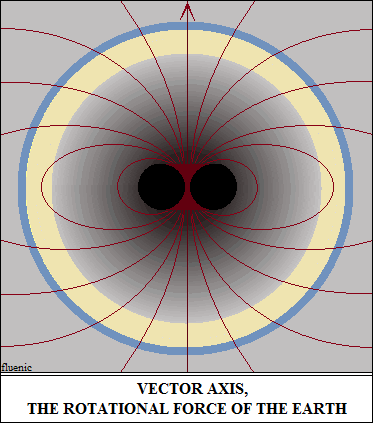
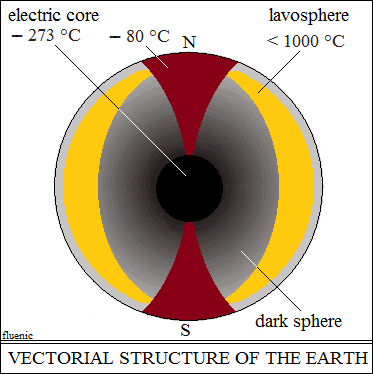
The earth's core (electric core) is the immense density of oriented vector
space, in which with the axial rotation of the vectors it oriented the
surrounding vector space, forming the orthogonal circuit called magnetic.
The centripetal force and axial rotation of the vector space in the electric
core compresses, orients and rotates the magnetic axis (right hand rule).
Beyond the magnetic axis, the repulsive vector forces of the parallel-oriented
space extend the circuit around the axis, forming the density gradient
of the
terrestrial vector space. The high density of the gradient, which emerges
from
the core and through the poles of the magnetic axis, extends beyond the
orbit
of the moon. Atmospheric pressure is the orientation density of vector
space.
The orientation density of vector space, in the terrestrial vector structure,
presents the gaseous, liquid and solid states as gradient densities.
In the structure of the sun, the photosphere floats on the dark sphere.
In the structure of the earth, lava floats on the dark sphere, with reactions
similar to the solar photosphere, but on a different level. In the outer
part of
the lava layer, the density gradient, composes the hydrogen structures,
into
chemical elements. At the internal surface, the higher density of the
gradient
decomposes the elements, raised to the surface by Archimedes' principle.
With these reactions, the lava formed the earth's crust, either
with the light elements brought by Archimedes' principle,
or with heavier elements brought by volcanic eruptions.
In the earth's core, the closed vector space circuit (electric), has the
maximum possible density, around the vector axis, in the solid state.