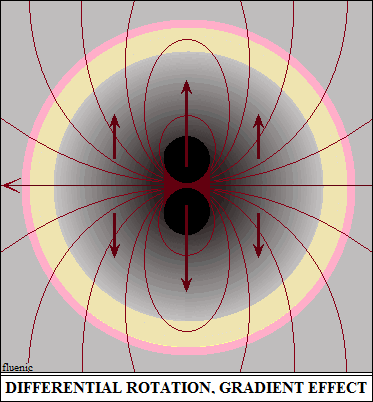
Differential rotation,
gradient effect.
The sun is a vector space structure oriented in orthogonal circuits, by
vector
forces of attraction and repulsion. One circuit forms the structure of
the core,
called the "electrical circuit" and the other circuit forms
the gradient of the
density of the oriented vector space, called the "magnetic".
The gradient is
the uncompressed part of the magnetic circuit, in which the vector
repulsion forces extend it in the equatorial plane to 1-2 light years.
At 700,000 km from the center, a layer of vector space density formed
microscopic vector structures of hydrogen, the image of the sun, the
photosphere. The photosphere surrounds the dark sphere, the gradient of
vector space density oriented, exponentially increasing towards the center,
on which the sphere floats, having a much lower density. The image of
the
sun exposes to view a differential rotation movement of the photosphere.
Differential rotation being a movement inherent to macroscopic vector
structures, it must have an explanation. The axis of a vortex in the Earth's
atmosphere shows the helical shape of the upward movement, in the center
of the vortex reminiscent of the right-hand rule. In the center of the
sun's
structure, the density of the vector space oriented helically in the vector
axis,
not linearly, may be the cause of the differential rotation of the sun's
structure. Yes, the rotational motion can only be the effect of the interaction
of the vector property of orthogonality. The huge density in the vector
(magnetic) axis, in the area compressed orthogonally by the nucleus is
the
high intensity of the rotation, towards the poles, the repulsive forces
decreasing the density, the intensity of the rotation also decreases.
In the internal structure of the sun, the intensity of rotation is seen
in the
drawing below. Obviously, differential rotation occurs in both the
photosphere and the dark sphere. Differential rotation, dependent
on the gradient of the orientation density of the vector space,
also moves the planets in orbits. Axially, the gradient is simply
flattened by the polar open vector repulsive forces.