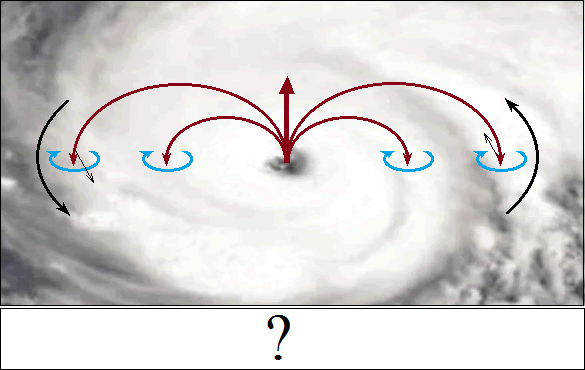
Gradient, and differential
rotation.
Differential rotation is a characteristic of macroscopic vector structures.
In the solar system, the planets do not rotate around the sun, they rotate
simultaneously with the gradient of the density of the oriented vector
space
(with the magnetic field). Kepler observed that the Earth moves in orbit,
faster at perihelion (January 3) and slower at aphelion (July 4). If the
Earth
rotates simultaneously with the solar gradient, it follows that the rotation
of
the gradient, of the solar system, is differential. The rotation speed
decreases
with radius, as does the density of the oriented vector space from the
sun's
gradient. We have no cause for differential rotation and differential
rotation
is preserved over radii of thousands and millions of light years, as far
as the
gradients of the structures extend. It follows that the rotation itself
must be
"at the carrier", that is, in the density gradient of the oriented
vector space.
Yes, the oriented vector space carries with it the property of axial rotation
of
vectors. So, the gradient of the density of the oriented vector space
carries
with it the "cause", the gradient of the differential rotation
speed.
The cohesion of the symbiosis of the rotation velocity gradient, with
the
density gradient of the oriented vector space, forms distinct bands:
Differential rotations with bands are the vortices of the Earth's atmosphere,
filmed from high altitudes. The images of the surface of the planet Jupiter
are also suggestive, but also the shapes left by the lavasphere, in the
formation of the lithosphere, on land and in the oceans of the Earth.
The most expressive, however, are the arms of the galaxies. In the solar
system, the gradient of the density of the oriented vector space, rotates
differentially, the dynamics of the planets apogee/perigee, like the dynamics
of hydrogen in the photosphere of the sun. And the dynamics of hydrogen
in
the photosphere supports the movement of the differential velocity gradient,
in addition to the up/down movement, there are also left/right movements.