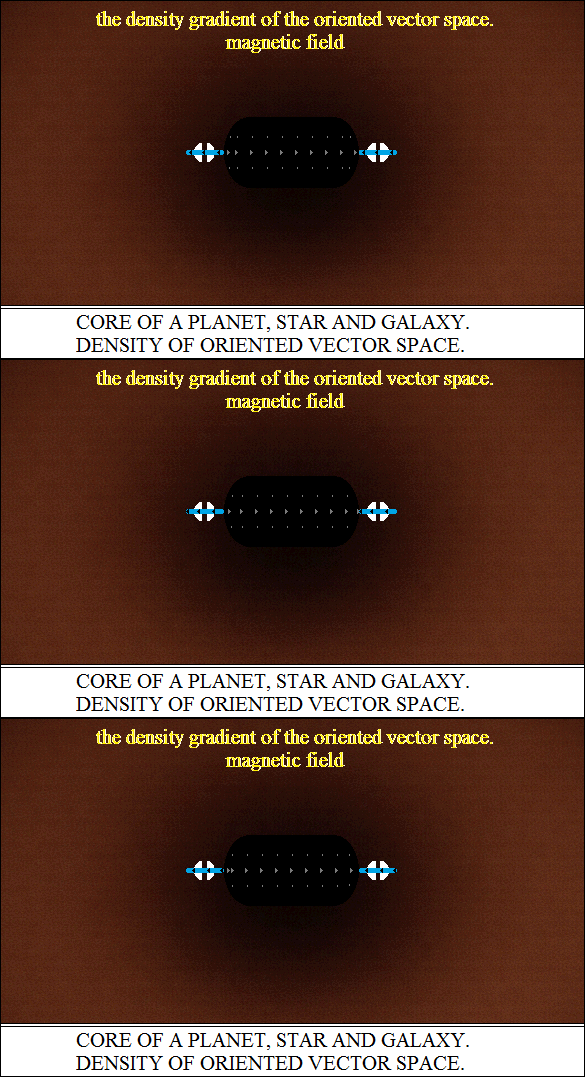
Axial rotations.
The reason for differential rotation lies in the deep "reading"
of the interaction
of vector properties in the microscopic structure of hydrogen: Orientation
in direction and sense, attractive forces and repulsive forces, then axial
rotation, which orients the vector space in two orthogonally closed circuits.
Orthogonality property.
When the vector space is oriented in a closed circuit, the axial rotation
simultaneously orients another closed circuit around it (it is the right
hand rule).
The vector space in the two circuits thus become mutually oriented by
the
rotations of their vector axes, establishing the equilibrium of this hydrogen
structure. Through this balance, axial rotations produce the dependence
of
the stability and instability of the structure, the well-known connection
of
"electromagnetic" oscillations. The property of axial rotation
of vectors,
hitherto hidden, shows how essential it is for the fundamental form of
the
existence of nature, producing differential rotations and stability, of
the
macroscopic structures in the universe. It follows that orthogonality
is not a
vector property, but the effect of the axial rotation of vectors. The
axial
rotation property of vectors is the cause of the orientation of vector
space
in orthogonally closed circuits and of differential rotations (vortices).
The synchronization of the dependence of the differential rotation on
the