Gravity or density.
Microscopic nature.
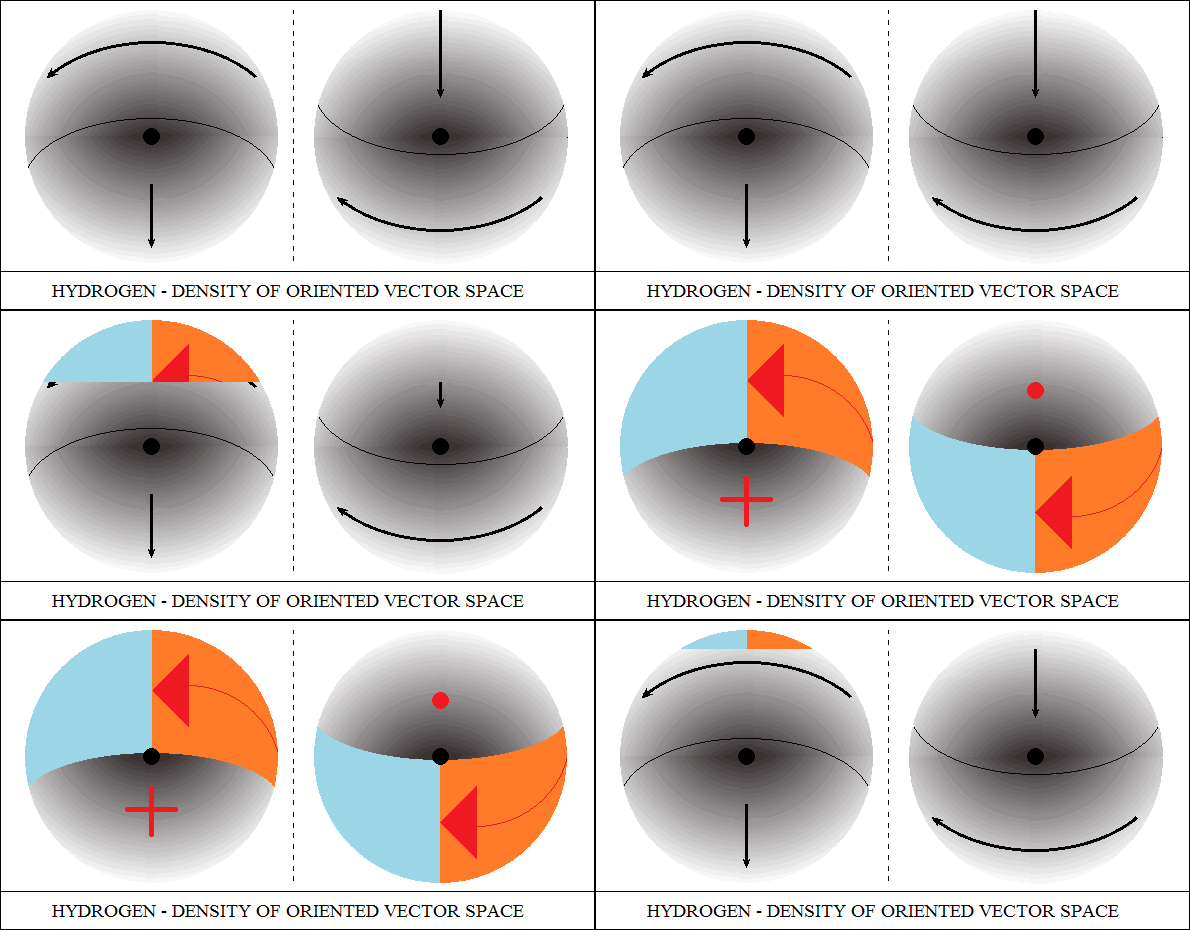
The existence of nature consists in the orientation density of vector
space.
Nature begins with the vector structure of hydrogen. Vector circuits and
their
polarities are not singular or point-like wires, they are vector spaces
with
different densities of orientation. In vector space, the properties of
vectors
(the force of attraction) form a closed vector circuit. Simultaneously,
the axial
rotation property of the vectors forms, in their direction of rotation,
another
orthogonal closed vector circuit (right-hand rule). If the circuits are
microscopic,
they mutually compress their orientation density, as an effect of the
vector
forces of attraction from the closed circuits. Being microscopic, each
circuit
surrounds only one segment of the other circuit and the segments become
a
kind of "magnetic" axes oriented orthogonally. The axes, closely
connected
orthogonally, form a kind of solid knot, a core. In the uncompressed
segments, the repulsive forces extend the density of their orthogonally
oriented vector space, decreasing radially, having the nucleus at its
center.
From the nucleus, the density of the extended segments decreases radially,
as
an effect of the repulsive vector forces and forms a sphere of orthogonally
oriented vector space around the nucleus (like a tennis ball). This sphere
is
the extension of the uncompressed circuit segments, as the effects of
the
repulsive forces are the very polarities of the structure, paired, the
forces of
nuclear bonds. In the Rutherford experiment, this state was called
"nucleus and empty space". Instead of kernel, the name node
of vector space would be more appropriate. And since
vector space is infinite, we can call it the node of infinity!
Macroscopic nature.
If the circuits are macroscopic, the maximum density of oriented space
will
be in the core completely surrounded by the other circuit (called magnetic).
The (electric) core surrounds only a segment of the magnetic circuit,
forming
the magnetic axis. The density of the oriented vector space, the magnetic
field, is maximum in the magnetic axis, as an effect of the vector forces
of
attraction in the nucleus and decreases with radial distance, as an effect
of the
vector forces of repulsion. The magnetic field, that is, the oriented
vector
space, presents the state of a radial gradient, exponentially increasing
towards
the center, in the nucleus. In this centripetal increase in the density
of vector
space, there is a density value in which microscopic vector structures,
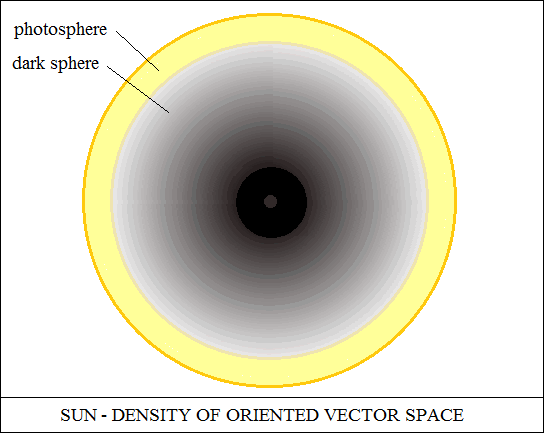
hydrogen atoms, easily compose, constituting the photosphere of a star,
like the sun. In the photosphere of the sun, the variation of the density
of the oriented vector space, decomposes (predominates) and composes
(predominates) vector structures of hydrogen, an alternating process,
with an 11-year cycle - the activity of the sun. The interactions of the
density
of the oriented vector space with hydrogen, confirm the thinking of Aristotle
and Archimedes. The photosphere covers a dark sphere with a radius of
seven hundred thousand km, in which there is only the density of the oriented
vector space, on which the boiling photosphere floats. The energy of the
density of this dark vector space rotates the solar system. Who can imagine
how space has this fantastic potential energy, replacing plasma and gravity?
Although, the structure of a galaxy clearly shows, the mystery of dark
energy
around the nucleus called black hole. Now, there is an explanation: the
density of oriented vector space. In the dark sphere, the vector structures
of
hydrogen are radially repelled, as Archimedes says, and oscillations are
impossible in the "concrete" of the density of oriented vector
space.
In other words, density clearly disproves gravity. Of course, the reality
of
phenomena does not change as we imagine it. If we say black hole and dark
energy, or magnetic field and electric current, we do not modify the
properties of the oriented vector space. A similar phenomenon exists
in the structure of the earth, where instead of the photosphere, density
produces reactions of composition of chemical elements. In the earth's