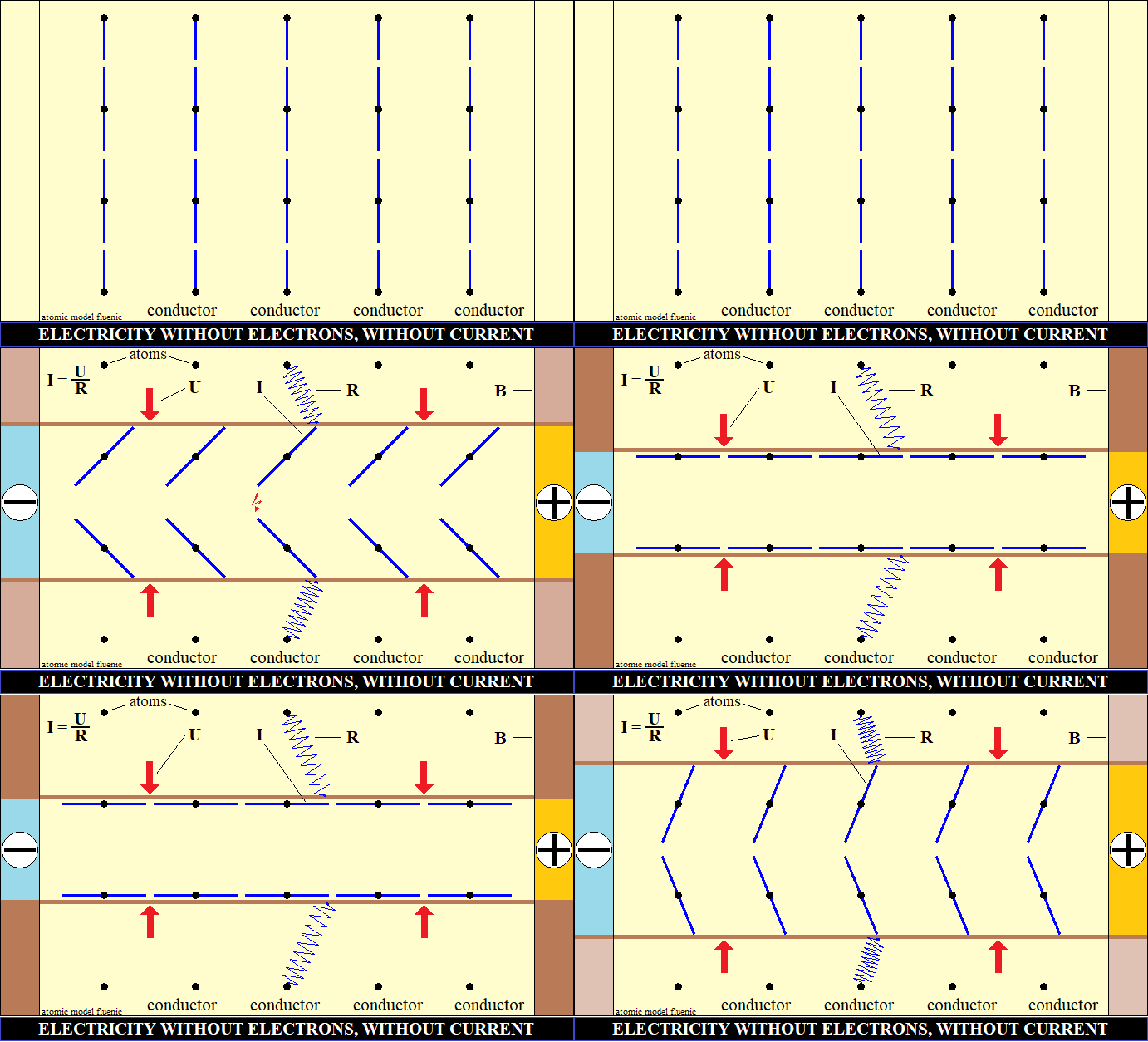
Ohm's Law.
Vector space oriented in orthogonally closed circuits, formed macroscopic
and microscopic vector structures: "electric and magnetic" circuits.
People on planet Earth, such as Stephen Gray, Alessandro Volta and
Michael Faraday, have experimentally succeeded in orienting vector space
through metallic wires, but only the electrical circuit. The magnetic
circuit
is still the gradient of the density of vector space oriented in a closed
circuit.
Reason why its interactions are not known. Then Hans Christian Oersted
noticed by chance that when the electrical circuit was closed,
a magnetic
field appeared around it and disappeared when the circuit was interrupted.
In reality, the vector space oriented by the metallic wire, when closed,
orients the orthogonally closed circuits: "electric and magnetic".
The fact
that one of the circuits is closed through the wire is a way of using
the
energy of the vector space, other than the
lift of aircrafts. From this point of
view, we analyze the vector interpretation of Ohm's law. Ohm's law says
that the intensity of the electric circuit is directly proportional to
the voltage
and inversely proportional to the resistance. The law says nothing about
the interaction of the magnetic circuit, for which the "current of
electric
charges" was invented. The vector interpretation shows that the intensity
is the orientation density of the vector space in the orthogonally closed
circuits, "electric and magnetic", which compress each other,
so, implicitly,
they are proportional. Moreover, the voltage and the intensity, or rather
magnetism and electricity, cannot be separated, having a mutually
dependent existence. The vectorial interactions between the photosphere
and the dark sphere show the cause of the difference between the vectorial
and materialistic interpretation. The dark sphere shows the vectorial
interpretation, where the density "tension", "pressure",
obviously, has no
resistance. The interaction of the orientation density of the vector space
in the photosphere, shows the materialist interpretation, Ohm's law.
Here, the intensity and voltage are directly proportional, that is, the
same
orientation density of the vector space, but, disturbed by the presence
of
hydrogen structures, "constituting resistance", which decompose
into
radiation, as the electrode decomposes in electric welding. In the welding
arc, the interactions of vector properties decompose and compose the
connections of vector structures between the electrode and the welded
bodies. The light from LEDs are point oscillations of vector connections,
without structural modifications, determined by the stability of the density
through the junction. So, Ohm's law is a correct interpretation only in
the
materialist conception, where the interactions
of vector properties are ignored.