Macro and micro.
Vector space oriented in orthogonally closed circuits forms macroscopic
vector structures, stars and microscopic vector structures, hydrogen.
The structure of stars is asymmetric, because the vector circuit
called
the electric nucleus is completely surrounded by the other circuit called
the
magnetic one. The magnetic vector space is compressed and oriented only
in the segment that passes through the nucleus, beyond that, the repulsive
forces form the density gradient of the vector space, the nucleus has
no
gradient, determining the asymmetry. From the core, the repulsive forces,
begin curvilinearly the density gradient of the vector space, forming
the
"funnel" polar zones and then the lenticular shape of the stellar
gradient.
The polar zones are imagined, a magnetic axis. Obviously, the north pole
and the south pole are positive and negative vector polarizations.
The circuits mutually compress the density of the orientation of space
in direction and sense, establishing a static equilibrium, the immense
potential energy of the stars. Macroscopic structures have different
magnitudes, amplified by the generation of hydrogen structures and the
formation of systems. The electric wires that illuminate the streets are
the
same circuits of the orthogonally closed vector space, which mutually
compress their density. The electrical circuit, the "core" is
the conductor,
where the density (intensity) of the vector space is compressed and oriented
in the direction and sense, along the entire length of the conductor,
magnetic.
This process, called "propagation", are the repulsive forces
of the vector
space oriented parallel around the conductor and called the magnetic field.
The vector space density in the two circuits is energy.
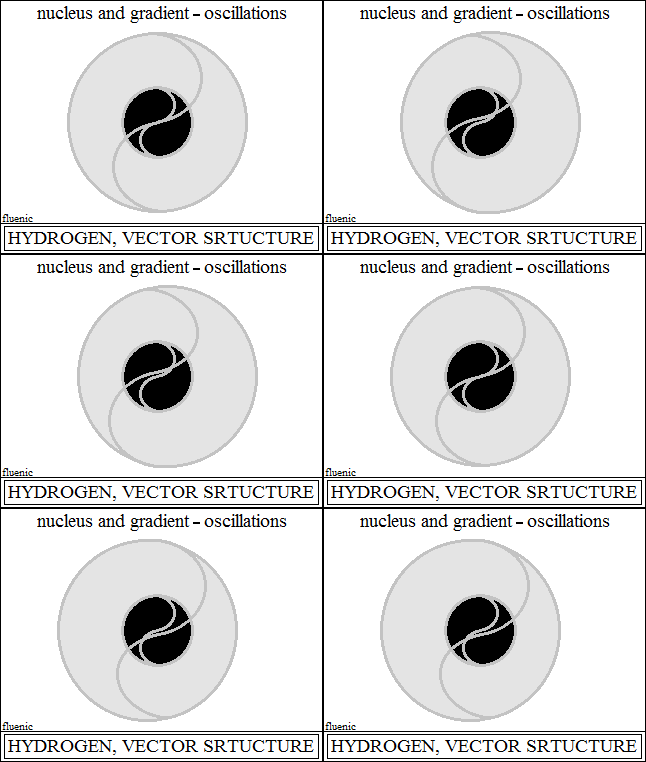
Hydrogen structures have orthogonal symmetry, determined by the
microscopic size. The density vector space in the gradient of stellar
photospheres is the only place where orthogonally closed circuits form
microscopic vector structures, called hydrogen. The space in the two
orthogonally closed circuits is identical in structure, shape and size,
arranged in a mirror image, but in an orthogonal plane. The circuits mutually
compress half of the orthogonal circuit, forming the core and their own
gradients, with exponential growth of density towards the core.
By mutually compressing the gradients in the core, the circuits establish
a
static equilibrium of the density, the potential energy of the hydrogen
structure. The core of the structure is not a torus, it is the space
with the
maximum density compressed orthogonally, by gradients. It looks like a
knot!
Thus, the density gradients of the closed spaces, delimited by orthogonality,
form a sphere with the core in the center. In the drawing it looks like
a
tennis ball. The symmetry of the hydrogen structure justifies the main
characteristics: stability, which determined the name of "indestructible
atom"; lack of open polarities; lack of rotational movement, canceled
by
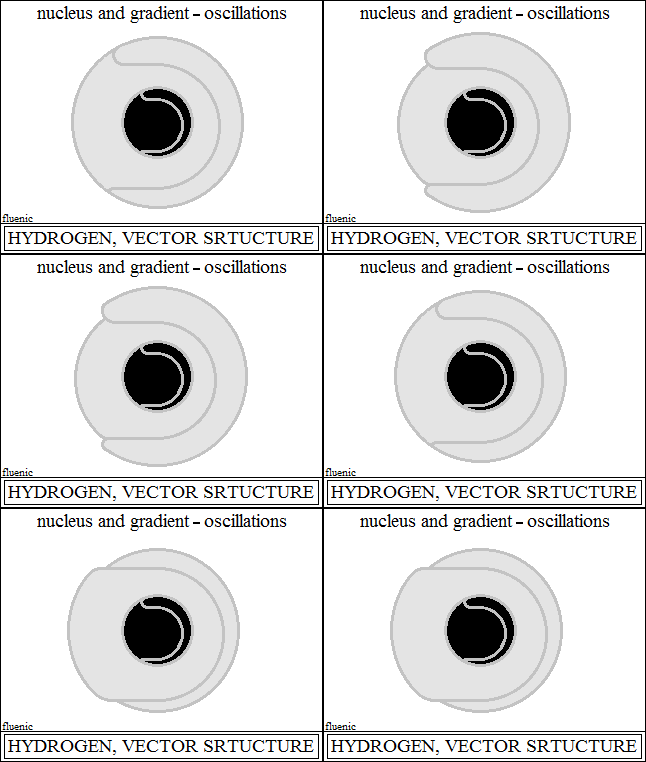
orthogonal symmetry. The essential characteristic is the exit from the
static
equilibrium of the gradients, under the action of external stimuli.
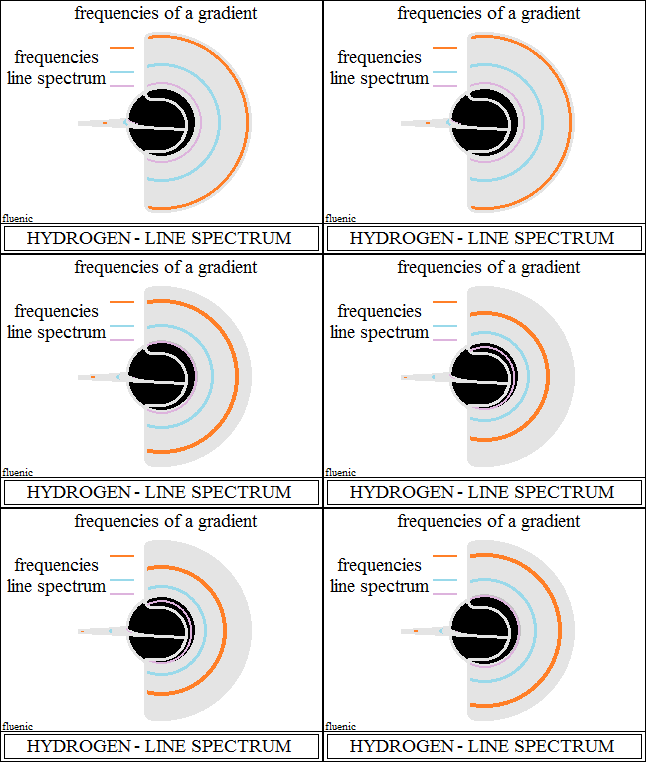
The exit from equilibrium causes alternative compressions between
gradients, generating a spectrum of oscillations, induced in vector space.
This feature is demonstrated by the dynamics of hydrogen in the
photospheres of stars. Also important is how in the densities of hydrogen
structures (in the lava of planets), gradients open circuits and close
them between them, forming bonds, the native elements.