The paradox of the
photosphere.
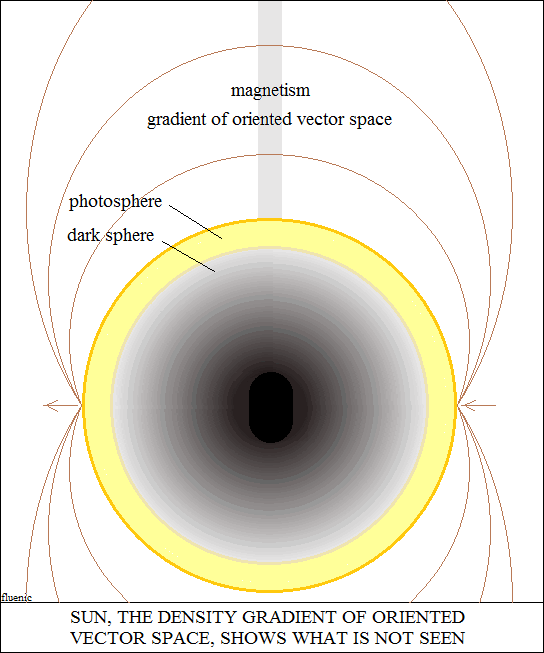
The paradox comes from the question: how does the plasma of the
photosphere boil, on a cold plate, on the dark sphere, with temperatures
below zero degrees? Obviously, boiling refers to the temperature and light
of the photosphere. The answer is simple, the temperature comes from the
rain, in the photosphere it rains continuously, with the cold nuclei,
of the
vector structures of hydrogen. In the photosphere, the density of the
oriented
vector space continuously forms hydrogen vector structures.
Their high-density nuclei, in free fall, "rain" through the
increasing density
gradient and become a spectrum of frequencies emitted radially in the
form
of light. Between the surfaces of the photosphere, the difference in the
density of the oriented space is huge. From the internal surface, the
vector
oscillations, which are vector space with omnidirectional orientations,
are
instantly reoriented by the dark sphere. In the energetic interpretation,
the
hydrogen nuclei, with potential energy, in fall and in interaction with
the
densification of the gradient, enter into oscillations and the potential
energy
finally becomes kinetic energy. The rain, the downward flow of nuclei
with
potential energy, continuously meets the upward flow of radiation with
kinetic energy, polarizing the energy state of the photosphere and the
temperature. Low temperature on the external surface and high on the
internal surface. This interference adds to the gradient regarding the
cause
of hydrogen decomposition. In this disturbed state of vector space, lightning
also occurs, macroscopic orthogonally closed vector circuits causing the
reproduction of stars. The complexity of interactions in the photosphere
is
called stellar activity. The density gradient of the oriented vector space
shows what is not seen, except the image of galaxies, where it is seen.