Priority.
Now I notice the logic of the formation of vector structures, that it
is
unlikely to have started with microscopic structures, forming hydrogen
clouds, which would give shape to macroscopic, electromagnetic vector
structures. The argument is the conditions of the vector space, much more
conducive to orienting macroscopically in orthogonally closed circuits
than
microscopic structures. Macroscopic vector structures being asymmetric,
the
vector space in one circuit is completely surrounded by the other circuit
and
is called electric and core, and the vector space oriented in the other
circuit
is called magnetic. The electrical circuit, the core, surrounds and compresses
the orientation of only a segment of the magnetic circuit, forming the
magnetic axis. The repulsive forces of the uncompressed vector space in
the magnetic circuit beyond the magnetic axis expand the size of the circuit,
taking a lenticular shape around the magnetic axis. In this configuration,
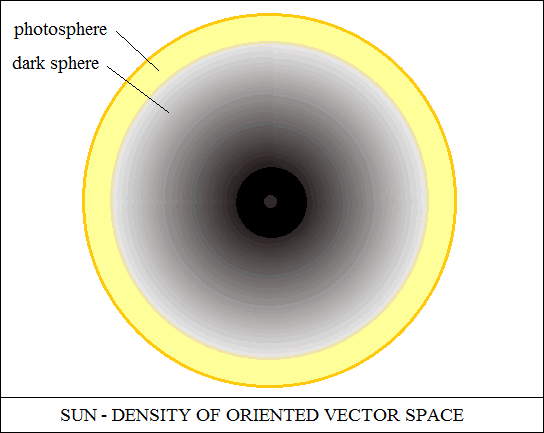
the density of the vector space called the magnetic field forms a density
gradient, increasing exponentially towards the nucleus. The density of
the
oriented vector space, increasing towards the center, passes through a
density conducive to the formation of microscopic vector structures, of
hydrogen, forming a layer of gas, of hydrogen, which covers a dark sphere,
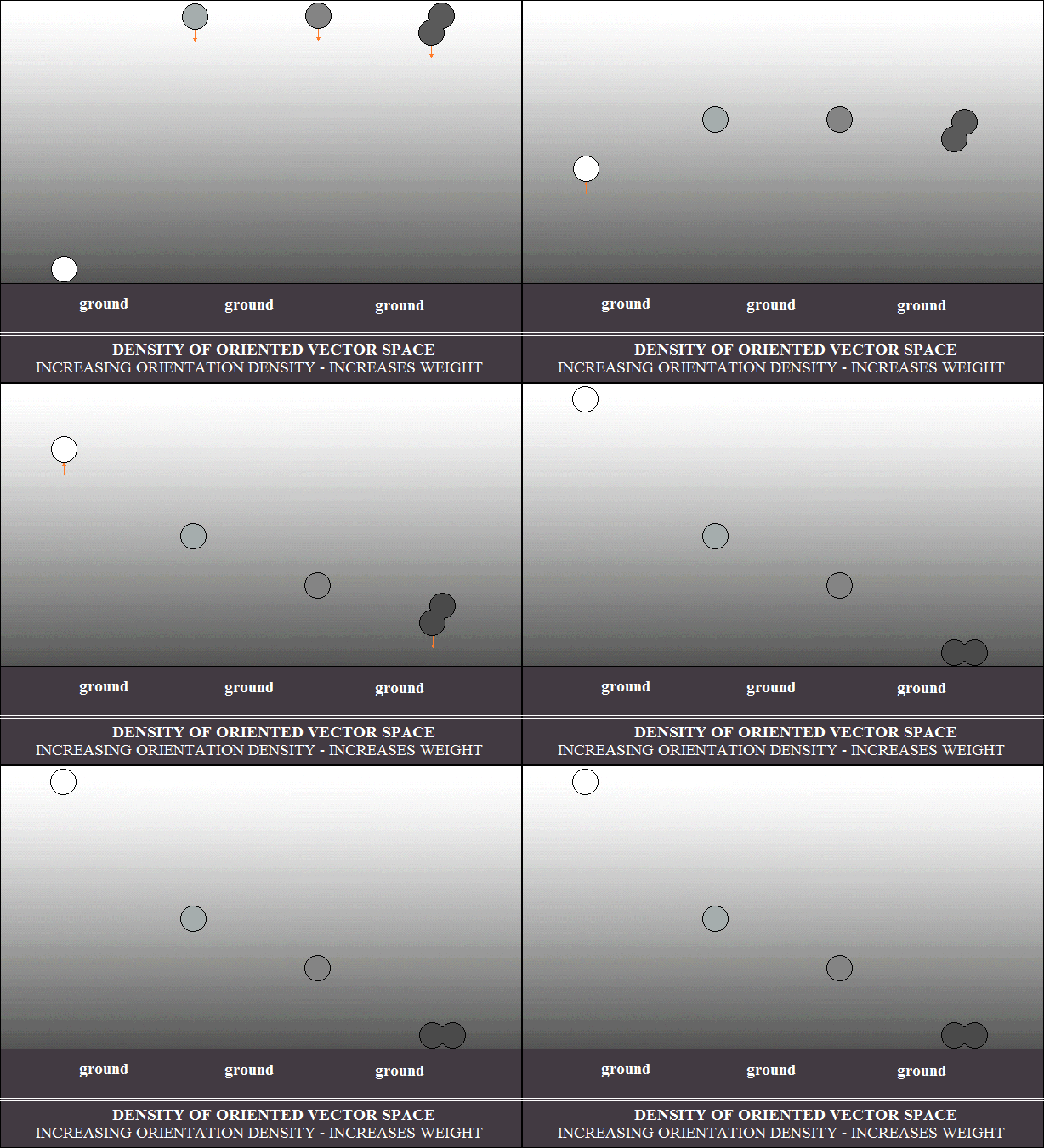
a star. The high density of the vector space in the hydrogen gas nuclei,
as the drawing shows, moves down, towards the suitable density, "raining
hydrogen". Having reached the suitable density in the dark sphere,
the hydrogen nuclei oscillate, decompose into a low-density frequency
spectrum and the "hydrogen vapor" moves up, to the suitable
density.
In the case of the sun, this cycle repeats itself every 11 years and is
called
activity. The cycle is just a sequence of the evolution of the photosphere
and the sun. Once, in the solar atmosphere, at maximum activity,
macroscopic vector structures, planets, were reproduced, which led to
the formation of the solar system. It follows that the phenomena of nature
are sequences of the density of the oriented vector space. Thus, in the
evolution of the earth, there were sequences of the density of the oriented
vector space, suitable for the union of hydrogen structures, forming the
elements of the periodic table. The sequence continued with densities
suitable for the composition of biostructures, the plant kingdom, and
parasites on the leaves, from which more ferocious parasitic species
evolved, the animal kingdom. The circulation of water density in nature
mimics the circulation of hydrogen density in the solar photosphere.